Music

Sunday, 4 November 2012

Dr. Fish (Garra Rufa)


GARRA RUFA the Fish Doctor

Dr. Fish Garra Rufa is one of the most familiar that heals and serves people, and that's why we have our very own Fish Doctor to serve them! Doctor fish is the name given species of fish: Garra rufa. Other nicknames include nibble fish, kangal fish, physio fish, and doctorfishen; in non-medical contexts, Garra rufa is called the reddish log sucker

Our “Fish Doctor"; graduated with a bachelor of fishery science, spent many years working and researching abroad and is also our Consultant for Lively Aquarium for the Garra Rufa Fish.

As a fish specialist, Fish Doctor oversees the health of the Garra Rufa doctor fish and its breeding at Lively Aquarium. This is achieved through the vigilant training and supervision of Lively Aquarium colleagues to ensure the best quality Garra Rufa Fish. Our Fish Doctor is also involved in carrying out various researches on Dr Fish (Garra Rufa ) for the company's future business development.

Thursday, 13 September 2012

Breeding Discuss Fish Successfully

 
BREEDING DISCUSS FISH 
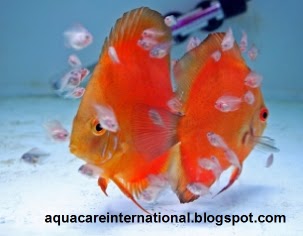
 The key to successfully breeding Discus lies in always providing them with supreme water conditions, keeping them in an aquarium that is large enough for them, giving them high quality food etcetera. Discus Fish is not a very easy fish to keep, and breeding them in aquariums is even harder. A well kept Discus pair will breed regularly in the aquarium, and there is really no special “fix” that will induce breeding in a couple that do not feel well. Most of the guidelines regarding Discus breeding will therefore be the same as for keeping Discus. Only those with previous experience from keeping easier species should try caring for Discus, since many Discuses have died in the hands of inexperienced aquarists. Discus fish are wonderful to keep – they are beautiful as well as charming – but they do require quite a lot of pampering. 

Discus Fish couple will not breed in an aquarium that is too small. A depth of at least 15 inches is required for these tall fishes. A 36 inches x 18 inches x 18 inches aquarium is therefore usually the smallest suitable standard aquarium for a pair. If you have a 48 inches x 18 inches x 18 inches aquarium you can even keep a group of 4-6 smaller Discus until they have formed their own pairs.
 
The best way to combat the nitrate is by performing frequent water changes. Changing 30-50 percent of the water each week is a good rule of thumb. The water temperature should be kept at 82 degrees Fahrenheit or higher, and the water must be very soft. Keep the pH as close to 6.5 as possible. Keep the levels of soluble waste as low as possible and never allow the nitrate level to rise above 20 ppm. Since your Discus will require a diet rich in protein, they will consequently produce a lot of waste products that will push up the nitrate levels in the aquarium.  The soft water means that you will have to monitor the pH value vigilantly. Soft water is a very bad buffer and the pH value can therefore drop very quickly and your Discus will not do well in acidic water. 

As mentioned above, your Discus will require plenty of protein in their diet. Professional Discus breeders usually give their fish beef heart. The beef heart diet should ideally be supplemented with other food types, such as spinach and bloodworms. Some high quality flake food will provide your Discus with extra nutrients, and additional vitamins can also be a good idea.

During the initial stage of the breeding process your Discus couple will start to defend a small region of the aquarium. Both the male and the female Discus will become highly territorial and guard this region together. They will continue by picking a spawning site and carefully clean it. Some Discus pairs clean a number of sites before they finally decide to place the eggs on one of them. The female Discus will swim over the spawning site and deposit her eggs in rows, and they male will swim behind her and promptly fertilize them. I wish to once again stress the importance of keeping your Discus in soft water. Hard water will make the protecting membranes that surround the eggs so hard that it is impossible for the sperm to get through. Hard water can therefore cause the eggs to stay unfertilized and no fry will develop. Hard water can also make it impossible for a fry to hatch.


Diet and Breeding of Parrot Fish

 DIET AND BREEDING

Diet of a Parrot Ciclids
Blood Parrots will eat a variety of foods including flake, live, frozen, and freeze dried foods. Sinking foods are easier for them to eat than floating foods. Most owners report bloodworms and live brine shrimp as a favorite treat. Foods high in b-carotene and canthaxanthin will help maintain their vibrant colors.

Breeding Parrot Ciclids
Although Parrots have been known to mate and even lay eggs, generally they are infertile. There have been sporatic cases of successful spawnings, generally when they have been crossed with a non-hybrid fish. Like other cichlids, Blood Parrots will tend the eggs and resulting fry fastidiously. As with any eggs, those that are infertile will turn white and rapidly fungus. The parents will eat infertile eggs to prevent them from spreading fungus to the fertile eggs. Once the eggs hatch, daily water changes of 25% are critical to ensure the health of the fry. Fresh baby brine shrimp are the optimum food during the first couple of weeks. Often pet shops will carry frozen baby brine shrimp, which can also be used. As they fry grow, they can be weaned to fine fry food.

Wednesday, 12 September 2012

Care about Puffer Fish

Pufferfish are slow swimmers, but can quickly ingest huge amounts of water to turn themselves into a virtually inedible ball several times their normal size and they are a live eater. The pufferfish is truly unique. Just by looking at a pufferfish, you can tell that it is no ordinary fish. Some have likened the puffer fish to underwater hamsters or even panda bears. Regardless of what you see when you look at pufferfish, you can't help but notice their expressive faces that sometimes even appear to be smiling. 

Aside from the pufferfish's unique looks, pufferfish have very interesting personalities. That's right, personalities. Pufferfish are said to be able to recognize their care givers. I have watched first hand as a puffer fish wiggled at the front of the tank begging for food, watching its owner carefully. Porcupine puffers are even said to spit water out of the top of the tank when they want food. I would not believe it if somebody told me, but I watched a puffer fish come out of its hiding spot when it heard its owner singing to it. It stayed at the front of the glass appearing to listen, and left to return to its nook only after its owner stopped singing. I don't know the explanation behind this, but it was incredible. It confirmed for me that the pufferfish is no ordinary fish! 

Of course we are all familiar with the puffer fish's unique ability to puff. Pufferfish puff up when they get scared. It is very interesting to watch but the behavior should never be encouraged because it puts a tremendous amount of stress on the fish's body... pufferfish can puff up to 2 or 3 times their normal size! Fish keepers who keep puffer fish are encouraged not to take them out of water when transferring them because puffing up with air instead of water can be especially dangerous for them.

If you notice your puffer fish behaving strangely, you may need to take action. We saw one of our puffer fish repeatedly throwing his body into the sand an ornaments inside the tank. It got to the point where he was doing it so hard and so often that he had gashes in his body from where the sand must have cut him. It wasn't long before we noticed some spots on the fins of our other fish and realized the tank had a parasite, Ich! Our pufferfish was trying to scratch himself! If you act fast enough, Ich can be treated with any one of a number of remedies available at your local fish store. The next time we see our puffer fish exhibiting this behavior, we will know what to do!

It seems the only thing our pufferfish enjoys more than lounging around the tank is eating! He is the first one to the food and there is seldom any left for any of the other fish unless he is distracted. We feed him silversides, krill, and prawn. It is fascinating to watch puffer fish eat. Most other fish seem to nibble on their food, but our puffer fish seems to swallow entire silversides in a single gulp! Sometimes he takes food straight from other fish's mouths, but fortunately none of the other occupants in the tank seem to have been hurt during such a heist.

One of the most frustrating things about saltwater pufferfish is that they usually cannot be kept with other puffer fish. Most fish stores will warn that two puffer fish may be extremely aggressive towards each. We made the mistake of putting a spiny burrfish into the tank and our stars and stripes puffer ended up taking a chunk out of the burrfish's face! We were very surprised to see this because our pufferfish had not bitten any of the other fish in the tank before. Needless to say, we plan to heed the fish stores' warning from now on.

Origin and Introduction about Arowana Fish

AROWANA FISH are freshwater bony fish of the family Osteoglossidae, also known as bonytongues. In this family of fish, the head is bony and the elongate body is covered by large, heavy scales, with a mosaic pattern of canals. The dorsal and the anal fins have soft rays and are long based, while the pectoral and ventral fins are small. The name "bonytongues" is derived from a toothed bone on the floor of the mouth, the "tongue", equipped with teeth that bite against teeth on the roof of the mouth. The fish can obtain oxygen from air by sucking it into the swim bladder, which is lined with capillaries like lung tissue. The arowana is an "obligatory air breather". Asian Arowana are very rare and noble fish that bear a close resemblance to the traditional Dragon of Ancient china. It is believed to be auspicious and symbolises strength, prosperity, luck and wealth - and provides any aquarist with good Feng Shui. Renown across Asia for their symbol of wealth, these fish have a life span in excess of 20 years, and are a beautiful investment for the perfect tank.

Asian Arowana are lifestyle fish often becoming the most treasured possession of the keeper. They are thought to become spiritually linked to the owner and protect them from harm. Their individual personalities are entirely unique.

We have developed long standing relationships across Asia with Arowana Fish breeders and distributors allowing us to hand pick stock from the top breeders and farms. Our exports are quality controlled before shipping and our shippers specialize in the transport of Live Goods and fish to any international destination.


Sunday, 9 September 2012

Effective Tips for Improving Flowerhorn Kok

Effective Tips for Improving Flowerhorn Kok


How to make flowerhorn kok bigger?
 
Effective helps on how to improve flowerhorn fish head growth. You will also find out the effects of different types of food in the development of a head humps. Head Growth of Flowerhorn Fish really depends from the origin of the fish there's a lot of origins Silk to Kamfa and Kamfa to ZZ crossbreeding process... in Kamfa and Silk you expected that 12% out of 100 are Kokster while in ZZ 80% are Kokster.


 Is there a Secret Feeding Formula?
Proper Care is the Secret Formula that makes your Flowerhorn fish beautiful...

I breed and raise my own fry and I realize the truth. I found out that some juveniles just naturally grow bigger kok and the other are late. I believe that 20% from my Breed are show quality while the other are Class A to AA. All were fed with the same inexpensive flowerhorn pellets OX Brand, yet some just naturally developed much larger head humps than others.

The truth is that there is really no secret feeding formula that make koks bigger. The answer lies on the genes. Some have it. Some don't. More on flowerhorn head growth genes.

The good news is that there are a lot of commercial pellets like XO Humpy Head, ALife, Hikari, and New Life Spectrum that are reasonably-priced but still contain balanced amounts of nutrients essential in the development of nuchal humps.

In choosing the best fish food brand, consider the 
Choose pellets that contains not less than 35% protein for growing fishes.
It should be formulated not to cloud tank water easily,
It should be readily available for purchase when you need to. These fishes take some time adjusting to new food and may not feed for days if you introduce new pellets abruptly.
Its size should be appropriate for the size of your fish.
 
Worms, Shrimps, Frozen Blood Worms and Other Live Food
Considering the special formulations of commercial flowerhorn pellets, there is really no need for feeding your fish with live food. They are especially tedious as feed and they easily deteriorate.

The biggest advantage of live food would be that they somehow rejuvenate the appetite of these fishes.
However, the risk of disease development and parasite infection easily outweigh this advantage. Cichlids are voracious eaters by nature, and they really don't need much pushing to eat when they are healthy. Find out more on how to improve flowerhorn head growth by boosting overall health.

If they are not eating well, chances are, they are sick, scared, or stressed. If your fish is sick, medical treatment is the immediate and effective solution, not live feeding. Find our more on how to deal with scared flowerhorns here.
Of all the live food (and unprocessed) out there, I prefer frozen bloodworms as they are widely available, inexpensive, and can be stored easily.

I find live worms bothersome to keep around. These also attract ants and other insects inside the house.


Friday, 7 September 2012

FISH CARE

FISH CARE
Remember the Discuss from Aqua Care Shop? You won them at a fair, brought them home to a aquarium full of water and planted plans with underground air pump, loved them with all your heart-and they died. Although Discuss Fish are really hard to care for, if you don’t know a few basic facts you can doom the critters before they ever really have a chance. Keeping your scaly pet alive and swimming isn’t a fishy matter, so read on for the watery basics.
 
RELOCATING

It’s a good idea to set up your aquarium tank and let it sit for a week before you anticipate putting Discuss into her new home. This gives the water a chance to dechlorinate and gives the "good" bacteria (we’ll talk about this later) a chance to grow. The absolute minimum for tank size is ten gallons; with anything smaller, you will have problems maintaining stable water chemistry and controlling temperature fluctuations.

When Discuss arrives at her new home, they be a little apprehensive about the impending switch to new waters. You can ease her fishy qualms by making the transition a gradual one. Float Wanda’s bag in the tank for a while to let the temperatures equalize. Then slowly begin adding small amounts of tank water to Wanda’s bag; continue for about an hour before you transfer Wanda to her new home. Avoid mixing the old bag water with the new tank water-you can’t be sure what kinds of parasites you have brought home in the bag.

If you’re planning on having several fish in the aquarium tank, don’t overcrowd them when starting out. You can add fish to the tank at a rate of one to two fish every one to two weeks. Try not to have more than one inch of fish per gallon of water, and be sure to research the fish you’re placing together so they don’t eat each other at the first opportunity. Fish that are grouped by their preference for the same water temperature, water type (hard vs. soft), and acidity (or lack thereof) will thank you in the end by living the longest.
Cleaning conditions

Discuss fish get used to the condition of the water they are living in. If you change all the water at once, the shock of an "extra clean" environment may be too much, and youa might find your scaly pal doing the dead man’s float. Cleaning overzealously will remove most of the "good" bacteria that Wanda needs to live. Good bacteria breaks down waste and toxins such as ammonia into relatively harmless nitrates. It needs time to grow so it can effectively clean the toxins in the tank.

When it’s time for your weekly water change, remove only one-third of the water to ensure you’re not drastically altering the water chemistry. Never use soap of any kind when you clean Wanda’s home. Although detergents are great for human habitats, Discuss Fish will show her displeasure by floating belly up. After removing the water, replace it with dechlorinated water the same temperature as the water in the tank. About once a week you can "vacuum" the gravel (gravel vacuums are available at the pet store) to remove food and other debris that settles at the bottom.


Advisable Freeding Process

FEEDING PROCESS


LOUHAN CICLIDS  [Flowerhorn] is like similar sized fish, astronotus ocellatus for example, need a live food integration to be healthy and in shape. Their diet can consist of live food, frozen food, and standard dry fish food [OX Pellets, Head ups and etc.] The live food should be of good dimension, or the fish could not notice it, earth worms and big meal worms or wax worm are accepted; moreover you can give small fish, poecilia reticulata could be a good choice since the high number of fry they spare monthly. Remember to feed every live food you choose, and in case of live fish be sure they are healthy.

Frozen food is another good solution, especially when you do not have the live one. Young Flowerhorn usually eat chironomus, brine shrimps, daphias and other frozen fish foods, for fry you can feed them with egg yolk while older ones could not notice them; at their place you can offer frozen fish for human use, you have a great choice, anyway if possible get freshwater fish and avoid the sea ones.

Both live and frozen food can pollute the water, so be sure that Louhan eats all the given food in 5 minutes maximum, in case of rests remove them fast; for this reason it is better to have an aquarium set up that allow you to clean fast without needing to move objects and maintain 30% water change every 3 days.

Dry standard fish food is a good complementary option, especially if it is of good quality. You can find special food produced for cichlids that usually consist of big pellets that Louhan like.

A Louhan cichlid should be feed two times a day Morning and Afternoon, everyday, anyway be careful with the quantities and avoid to overfeed it, reducing the food amount specially if it is really rich of nutrients.

Thursday, 30 August 2012

Aquarium Equipment Calculator

Accurate Calculator for your Aquarium Tank...

Here's a list of standard tank sizes. 

Size Style LxWxH
2 ½ 12x6x8
5 ½ 16x8x10
10 20x10x12
10 long 24x8x12
15 24x12x12
15 show 24x8x16
15 tall 20x10x18
20 long 30x12x12
20 tall 24x12x16
20 extra tall 20x10x24
23 long 3612x13
25 24x12x20
26 flatback 36x12x16
29 30x12x18
30 36x12x16
30 breeder 36x18x12
30 extra tall 24x12x24
33 long 48x13x12
37 30x12x22
38 36x12x20
40 breeder 36x18x16
40 tall 48x13x16
45 36x12x24
50 36x18x18
55 48x13x20
65 36x18x24
75 48x18x20
90 48x18x24
110 extra tall 48x18x30
120 48x24x24
125 72x18x22
150 72x18x28
180 72x24x24

TEST KITS for Flowerhorn Fish


 TEST KITS

I found this while browsing random stuffs, a good read. This is meant to be passed on.


Which Are Useful?

There is a seemingly endless array of test kits for testing everything from ammonia levels to phosphate levels. Does one really need to buy them? The quick answer is no. It is quite possible to have a healthy tank without ever buying a single test kit. However, test kits are extremely useful at eliminating guesswork when something goes wrong (e.g., fish appear stressed or die). In the following, we describe the test kits that are most useful and the conditions under which they are useful. 


Ammonia Test Kit

Get one! Ammonia test kits are cheap and will tell you whether your tank has elevated ammonia levels. This is useful in two circumstances. First, during the tank-cycling phase, regular testing for ammonia will tell you when the first phase of the nitrogen cycle has completed. Second, should you have unexplained fish deaths, testing for ammonia verifies that your biological filter is (or is not) working correctly.


Note: Even in an established tank, the biological filter can sometimes weaken or fail outright. Common causes include:

not cleaning the filter regularly (water can't flow through a clogged filter, where the nitrifying bacteria reside), 

naively adding fish medicines (antibiotics kill nitrifying bacteria (oops!) as well as disease carrying ones), 

Having too small a filter for the fish load, etc. 


Be warned: if you have fish deaths and subsequently ask the net (or a fish store) for advice, the first question asked will be ``what are your ammonia (and nitrite) levels?''. 


Ammonia levels are measured in ppm. At concentrations as low as .2-.5 ppm (for some fish), ammonia causes rapid death. Even at levels above 0.01-0.02 ppm, fish will be stressed. Common test kits don't register such low concentrations. Thus, test kits should NEVER detect ammonia in an established tank. If your test kit detects ANY ammonia, levels are too high and are stressing fish. Take corrective action immediately by changing water and identifying the source of the problem.


Warning: Amquel and other similar ``ammonia-neutralizing'' water additives are incompatible with most ammonia test kits. Water treated with Amquel will falsely test positive for ammonia, even when ammonia is not present. Test kits using the ``Nessler'' method are known to give false readings under such conditions. 


Nitrite Test Kit

You might want to get one of these! Nitrite kits are cheap and are useful in the same circumstances where an ammonia test is useful. The only time a nitrite kit provides information that an ammonia kit can't is while testing for completion of the second phase of the nitrogen cycle. As in the case for ammonia, if your test kit detects nitrite, your biological filter is not working adequately. Once a tank has cycled, nitrite kits are pretty much useless. (If the bio filter in an established tank isn't working, both ammonia and nitrite levels will be elevated.) 

Nitrite is an order of magnitude less toxic than ammonia. Thus, one common saying about tank cycling is: ``if your fish survive the ammonia spike, they'll probably survive the nitrite spike and the rest of the cycling process.'' However, even at levels above .5 ppm, fish become stressed. At 10-20 ppm, concentrations become lethal. 


Nitrate Test Kit

Get this kit! Nitrate levels increase over time in established tanks as the end result of the nitrogen cycle. (The only exception to this rule is heavily-planted tanks and some reef tanks, which MAY be able to consume nitrogen faster than it is produced.) Because nitrates become toxic at high concentrations, they must be removed periodically (e.g., through regular water changes). Having a nitrate test kit helps you determine whether or not your water changes are removing nitrates quickly enough. 

Nitrates become toxic to fish (and plants) at levels of 50-300 ppm, depending on the fish species. For fry, however, much lower concentrations become toxic.


Note: A nitrate test kit is only of limited value in determining whether the nitrogen cycle has completed. Most nitrate test kits actually convert nitrate to nitrite first, then test for the concentration of nitrite. That is, they actually measure the combined concentration of nitrite and nitrate. In an established tank, nitrite levels are essentially zero, and the kits do properly measure nitrate levels. While a tank is cycling, however, a nitrate kit can't tell you how much of the reading (if any) comes from nitrate rather than nitrite.


PH Test Kit

Get one! These kits are extremely cheap, so there is no excuse for not owning one. You will want to know the pH of your tap water so that you can select fish whose requirements meet your water conditions. In addition, you will periodically want to check your tank's pH so that you can be sure it stays stable and doesn't increase or decrease significantly over time. 

In some cases, tank decorations (e.g., driftwood) or gravel (e.g., made of coral, shells or limestone) change the pH of your water. For example, tank items may slowly leach ions into your tank's water, raising the GH and KH (and pH). With driftwood, it is not uncommon to have the wood slowly leach tannins that lower the pH. 


General Hardness (GH) Kit

You may want to get one of these, but having one is not critical. You don't need to know the exact hardness level. Knowing whether your water is ``soft'', ``very soft'', etc. is good enough. Your local fish store, or, PALHS for that matter, may be able to give you sufficient information.


Carbonate Hardness (KH) Kit

This kit is not critical to have. By regularly monitoring the pH, you can figure out whether your KH is ``high enough''. That is, the KH should be high enough that your pH stays stable over time. If you have trouble keeping the pH stable, you may want to increase your tank's buffering capacity. Your local fish store, or, PALHS for that matter, may be able to give you sufficient information as to your KH value.

A KH kit is, however, indispensable to plant enthusiasts who use CO2 injection. It is also strongly recommended that you get one if you want to change the pH of your water, and it is a very useful diagnostic tool if you are experiencing pH stability problems.

Wednesday, 29 August 2012

Advisable and Effective Nitrification Process


I wont go all scientific with you, no scientific terms aside from Ammonia, Nitrite and Nitrate..this is just a simple explanation of what happens in all of our established tanks..things you might know already..just a recap for newbies and old fishkeepers alike.

Ammonia, Nitrites - in our cycled tanks we should have zero (0) of these two. 

Nitrates - not so harmful in short term exposure to our fish. This can be taken out through waterchanges..or with a denitrator..or with an algae scrubber.. I'd still stick with the almighty waterchanges though 

It doesnt mean that if you tank is crystal clear it is "clean", to tell you the truth most of the time its not. Why? because there are many other factors needed to be obtained to be able to say that our tank is in pristine condition. First off, ammonia.. Fish give out ammonia when they breathe, eat, urinate..etc. what do we do with ammonia? We let our beneficial bacterias (BB's) process it..they consume it..they eat it..yummy.. we also get Nitrites in our tank, what do we do? we dont do anything, we let our friendly BB's do the dirty work yet again..oh yea, these kind of BB's are from a different tribe but hey they consume our Nitrites...Is our tank safe now? You can say that but we still have our Nitrates, do we let our BB's get rid of em?NO! this time do your share,,, do a waterchange..please. 

Simple huh? This is the Nitrification process..Bow.

Oh yea, another note. When you see your fish behaving oddly or acting out of the usual, remember this. Check your water parameters.. and you might find your answer.

Guys. Please feel free to add more info..correct me if Im wrong or whatever but for what its worth I hope this helps..

Note: The more medias you have in your filters the better..meaning, theres more room (surface area) for our friendly beneficial bacterias to grow and thrive..the more they are (BB's), the more Ammonia, Nitrite and some Nitrate they can process..meaning, you have more room for error..its safer to "overfilter" than to "underfilter" and "sakto-filter". 


Salt is Salt... Very Effective for Flowerhorn Ciclids

"My views toward salt are very simple... Don't use it unless you need to. When you do need it, use it in the right amounts. And finally, don't believe that salt is a miracle cure for everything. It does have it's limitations and it's up to you to monitor the progress of your sick fish and decide if more potent meds are needed to help your fish recover.


These are the reasons why I like salt:

1) It does not hurt your filter (will not kill your nitrifiers)
2) Carbon does not take it out of the system
3) If you have a UV system... you don't have to turn it off.
4) Its VERY cheap... doesn't cost a fortune to treat a 100+ tank
5) Will not push very sick fishes "over the edge" like many meds
6) Can be used on most fish species that are sensitive to meds
7) Is not carcinogenic like a lot of meds out there.
8) Has a relatively wide margin for error in dosage
9) Found almost anywhere
10) Versatile... can be used as a long term bath (2 weeks) or a short term dip


What salt will do:

1) Relieve nitrite poisoning (Brown Blood disease) by displacing nitrite ions away from gills membrane.
2) Eradicates a large number of external parasites including ich, chilodonella, costia, trichodina, oodinium (velvet).
3) Combats bacterial, fungal infections and ammonia burn.
4) Kill all salt sensitive plants in your tank (watch out for this one  )
5) Recharge ion exchange resins (ammo-chips, water softener "pillows")
6) Can be used to disinfect a used, empty tank by apply it as a "paste"
7) Ease osmoregulatory stress... but only happens when fish are dumped from water of one osmotic pressure into one which is very different. This problem is not a concern because we are dealing with FRESHWATER fishes. Exception is when the fish has a very serious open ulcer.


Salt is NOT effective in:

1) Treating fish lice (argulus), anchorworms (lernea), skin and gill flukes, internal parasites.
2) Replacing electrolytes and trace minerals (unless you are using a marine salt mix which also has buffers that will increase your pH).
3) Treating viral infections
4) Iodine from table salt will NOT kill your fish. The low levels present in table salt will not reach toxic level, even at treatment levels. Your fish will die of osmotic shock or high salinity way before iodine becomes toxic. If you are still not convinced, cheaper alternatives to aquarium salt are non-iodized table salt, kosher salt, water softener salt (Home Depot sells 40 lb. bags for under $5 that are 99.8% pure NaCl).


All that being said, I don't believe that salt should be constantly used in the aquarium as a general tonic. They are freshwater fish and should remain so.


How to administer:


There are many "Rule of Thumb" guidelines for how much salt to add. Either, 1 tablespoon per 5 gallons, 1 tbsp/10 gallons, etc... If this has worked for you in the past, fine. I have always dosed my tanks at 0.3% (3 tsp/gallon) when needed, which is considerably higher than many suggest. Only exception to this rule is for nitrite poisoning where a teaspoon of salt will treat over 300 gallons of water. Many believe that the constant use of salt in low dosages is the reason why we are having problems with salt resistant parasites. And as a result, some parasitic infestations need to double the dosage to 0.6% to see any significant improvement.


My recommended dosage, even for ich, is 0.3% (which is a TOTAL of 2.5 lbs/100 gallons or 3 tsp/US gallon). The amount of salt added should be done in 3 equal increments over 3 days and left in the system for 2 weeks (that's 1 tsp per gallon per day for 3 days), in which time, the salt should be taken out through water changes. ALWAYS pre-dissolve the salt before introducing it to your tank! Measure out the desired amount of salt, add aquarium water to a bucket or cup (I use a 44 oz plastic "Big Gulp" cup) and stir like crazy until the salt dissolves. Slowly pour the salt solution into the tank and make sure you are not pouring it on top of your fish. I prefer to pour the solution in the path of a powerhead to help distribute it throughout the tank. A "blast" of concentrated salt solution may cause severe burns to your fish. Therefore, NEVER add salt directly to your tank.


For salt dips, a 1% solution (9 tsp/gallon) can be used for around 10-15 minutes and then the fish is returned back to clean aquarium water. For extreme cases and as a last resort, a strong 3% salt solution can be used. The fish must be constantly monitored and is basically kept in the bath until they roll over and is transferred IMMEDIATELY back to the aquarium. Fish will try to adjust to the changing salinity and the longer you wait, the more adjustments the fish needs to make. I'm not a big fan of salt dips because they are very stressful on the fish.


One final note, livebearers and cichlids will tolerate much higher levels of salt than many other freshwater fishes such as characins (tetras), loaches, and catfishes. So this practice is not recommended for all species."

Types of Filtration for Flowerhorn and other Ornamental Fishes


TYPES OF FILTRATION


Aquarium Filtration can be considered as three major types: mechanical, biological and adsorptive/chemical. 

• Mechanical filtration is necessary to remove particles from the water to keep the water sparkling clear and to maximise the efficiency of subsequent biological or adsorptive filtration. 

• Biological filtration is essential to ensure the breakdown of waste products in the aquarium by 'friendly' bacteria. This occurs most efficiently in highly porous media such as sponge and specific bio-media such as
 ceramic tubes and sintered glass. This media should only be lightly rinsed in aquarium water (not tap water) to maintain the bacterial colonies which establish. 

• Adsorptive media selectively remove various substances from the water. Examples include activated carbon which removes toxins, medications, dyes, etc. and specific resins which remove ammonia, nitrate, phosphate, etc. These products are also often referred to as chemical media,
although some would reserve this term for media which chemically modify aquarium water in other ways, such as peat which can acidify water by adding humic and tannic acid.

TYPES OF FILTER

Sponge filter
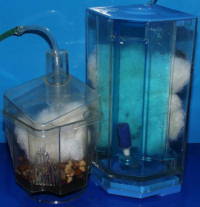
This is the most basic type of filter which consists simply of a sponge through which water is drawn by rising air bubbles from an air pump. The sponge acts mechanically, and once matured, biologically. These filters are ideal for small breeding and rearing tanks where a power filter might suck fry into the filter inlet.


Box Filter
These are also air powered and come in a number of sizes to suit small to medium sized tanks. The airflow draws water through the chamber of the filter which can be filled with the desired media. This type of filter can be moved between tanks to provide additional mechanical filtration using filter wool for example, or for adsorption of specific waste products using carbon or specialised adsorbent resins.


Internal power filter
This type of filter utilises an electrically powered centrifugal pump to draw water through the filter material, normally sponge. They may have additional chambers for adsorptive media or additional mechanical/biological media. They generally create a more powerful circulation than air-powered filters. They are ideal for aquariums in the 2ft - 4ft size range, and are useful in combination with external canister filters for large aquariums. They also provide useful extra mechanical filtration when used in conjunction with undergravel filtration.


HOT/HOB filters
Hang-On-Tank or Hang-On-Back filters are popular in the US and other regions, and are similar to internal power filters in terms of design principle and the size of aquarium that they are suitable for. Some use disposable cartridge systems to facilitate easier maintenance. The cartridge system may not cater for bio-filtration adequately, so models which include a sponge filter or an add-on like the BIO-Wheel are preferable.
The BIO-Wheel is an efficient bio-filter which can be added to different filtration systems and functions like a wet-dry filter.

Friday, 24 August 2012

Effective Breeding Tips for Flowerhorn Ciclids


Effective Breeding Tips for Flowerhorn Ciclids

Flowerhorn Ciclids is a rather easy task. There are, though, a few preparations that need to be made prior to breeding.Most important things you can do is prepare a new bare bottom tank to store the tiny fries once they are ready to leave the parents’ nest. Don't install any filter mechanisms as the small fries will get sucked into the filtration system. Air stone is particularly sufficient for aeration purposes.
Flowerhorn Ciclids breeding pairs is crucial prior to breeding. Desired phenotypic outcomes depend solely on the parents. Most of the time, it is almost possible to predict the external characteristics of the offspring produced by a pair of  Flowerhorn Ciclids . Thus, breeding Flowerhorn has an exciting aspect, as you would know the outcome of the selective breeding.  Flowerhorn Ciclids  breed year round. No external stimuli are needed for breeding purposes, but you must place the breeding pair in a clean, big tank. An aquarium heater regulated to 28degrees can be placed in the aquarium, but it is not compulsory. The use of a mechanical filtration system is sufficient to remove any feces and debris in order to keep the water quality in check as breeding pairs do not consume much food during this period.
Flowerhorn Ciclids breeding pair need to be well fed at a fixed regime until they are ready to spawn. A balanced diet is crucial to produce fish well laden with eggs and milt. Broodstock can be fed with various types of food including live and pellet feeds.
If you intend to breed your  Flowerhorn Ciclids , you will need a few pairs of fish. Some pairs might not be suitable for each other. Normally, a mating pair is put in the same aquarium with a partition in the middle to separate the two. The female will usually develop black stripes all over its body when it is time to mate, and appetite loss is quite common. Observations also show that the female’s genital papilla will start to swell. It is advisable to cover the sides of your tank with newspapers or any other materials. This provides adequate privacy for the mating pair as they are easily frightened or disturbed during the mating period. When they are ready, females will secrete pheromones, and this signals the males to start spawning. Initially, this pair will show aggression toward each other through the partition. When the pair has stopped showing this behavior, the partition can be removed. Once you remove the partition, if they still seem to be ‘fighting’, observe further. If one fish is standing its ground instead of running to another corner, it means that they are actually courting each other instead of attacking. If the pair continues fighting until one of them is visibly injured, it means that this pair is not ready or not compatible for the moment. Separate them and try again after a few days.
Flowerhorn Ciclids, If they are indeed a mating pair, the male fish will start to search for a breeding spot. In a tank with pebbles and gravels, the male fish will start clearing a chosen spot by removing all the pebbles. However, in a bare tank, none of this activity will take place. If you are using a bare tank, you should place a floor tile in the tank, because Flowerhorns will prefer a rough surface for spawning. Female Flowerhorns normally lay eggs close to the air stone, or where there’s a good flow of water, as this can help aerate the eggs. Moreover, because the water circulates in this area, a fungal attack on the eggs is prevented. Female fish will deposit rows of eggs, then the male will follow behind, fertilizing the eggs with its milt. This will continue until the female has deposited all of its eggs. No disturbances are allowed during the spawning moment as this will result in the parent eating the eggs as a natural protective measure.
A female Flowerhorn is able to produce approximately 500-2000 eggs at a time. The parents will usually take turns fanning the eggs with their fins to rid of unwanted debris or to prevent any fungal attack. It is advisable to add methylene blue (Hyperlink) or any anti-fungal treatment at a1mg/l gallon ratio to prevent a possible fungus attack.
The eggs will take a few days to hatch. When this happens, remove the parents. Once the parents are removed, be sure to practice proper fry management.

Thursday, 23 August 2012

Exact Origin of Flowerhorn Fish

EXACT ORIGIN 
OF FLOWERHORN FISH

Exact year that the flowerhorn fish existence is 1990's, there were fish breeders in Malaysia who were successful in creating a  flowerhorn fish. The species of the fishes that were used in the crossbreeding are still unknown to all except the people who created the fish. The flowerhorn fish is now known as the flowerhorn fish.

flowerhorn fish are easily distinguished from other cichlids. They have a prominent hump on their head. There are markings on the side of the fish. The different breeds of the  flowerhorn fish  are usually red or a shade of red. However, the hump and markings on the fish are always present.

Flowerhorn fish became a commodity overnight. This was because the fish as associated by many to be bringers of luck. This notion was brought about by the appearance of the awkwardly looking fish. The hump on the head of the fish resembles the high-forehead of the Chinese God of Longevity. The black marking on the fish are like scripts of characters or numbers.

The attention the fish is getting was even more increased when people start claiming that they are lucky since they started caring for the fish. The businesses of people started booming when they placed the fish in their shops. There was also an instance where a lucky lady won the lottery using the numbers that she saw on her fish.

The seemingly lucky  flowerhorn fish did not go with all positive hype. Not everyone approved of the flowerhorn. Since the  flowerhorn fish  was created through extensive crossbreeding of various cichlids, there are those who label the fish as man made. The fish was tagged as an abomination of nature.

The flowerhorn fish, unlike other products of hybridization, are fertile and can reproduce. What could have been considered as a miracle is also a reason why there are people who frown at the creation of the  flowerhorn fish . Environmentalists fear that the introduction of the  flowerhorn fish  in the wild will surely result to trouble. The people opposing the fish based their hypotheses on similar events where in foreign species were introduced to a stable community. An instance in the past was the introduction of the golden apple snails in the Philippines that was supposed to help alleviate the problems with food shortage but in turn became pests since they do not have natural predators. though riddled by bad publicity, the hybrid is still a favorite of  flowerhorn fish  enthusiasts. Their association with luck is not the only reason why they have been selling in the market. Their awkward appearance is enough to stimulate the curiosity of people.